Lab Middleware vs. Custom Integration: What Labs Actually Pay
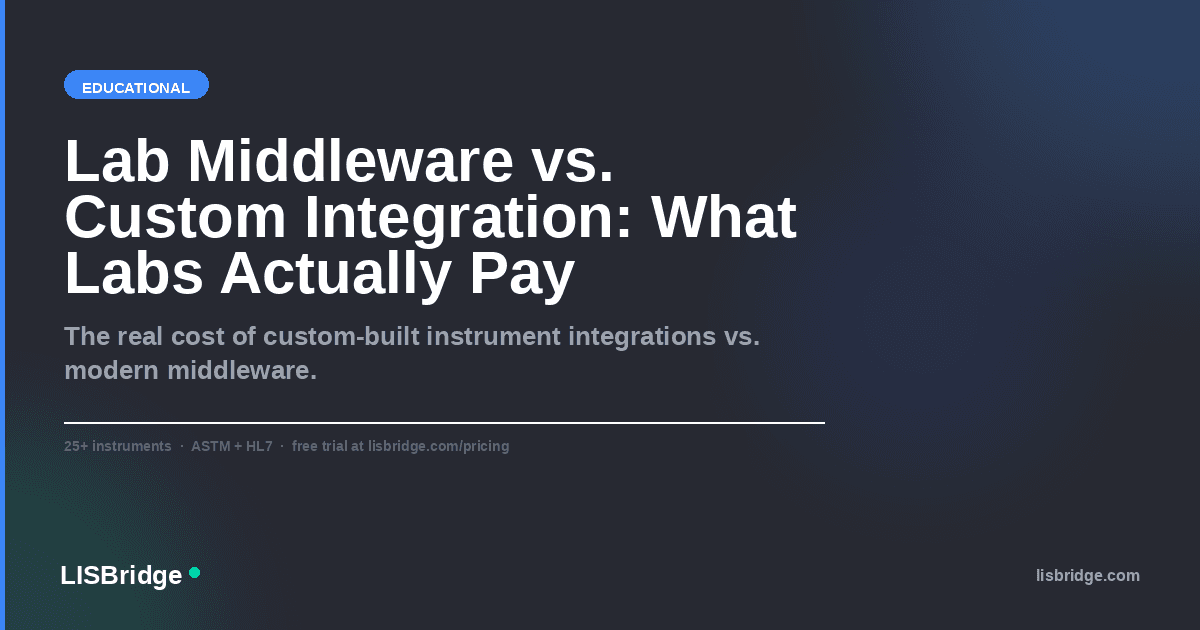
Custom lab instrument integration sounds flexible — but the real cost shocks most labs. Here's what you're actually paying vs. modern middleware, with honest numbers.
Lab Middleware vs. Custom Integration: What Labs Actually Pay
Every time a hospital IT team connects a new laboratory instrument to their HIS, they face the same decision: build a custom integration or use middleware. Most teams underestimate the first option and overestimate the second.
This post breaks down the real costs — not the sales pitch version — for both approaches. The numbers will be different for every lab, but the structure of the decision is always the same.
The Two Paths
When a new analyzer needs to deliver results to a Hospital Information System, there are two ways to make that happen:
Custom integration means writing code (or hiring someone to write it) that connects the specific instrument to the specific HIS. The code lives on your servers, is maintained by your team or a contractor, and gets rebuilt whenever either end changes.
Middleware means installing pre-built software that handles protocol translation generically — the middleware already knows how to speak ASTM E1394 and HL7, and has built-in parsers for dozens of instruments. You configure it; you don't build it.
Both can work. The difference is what you pay — upfront, ongoing, and in the long run.
What Custom Integration Actually Costs
Custom integration costs are notoriously hard to quote because they depend heavily on the instruments involved, the HIS target format, and whether your team builds it in-house or outsources it. But the cost components are consistent.
Initial Development
A typical custom integration project for a single instrument-to-HIS connection involves:
- Protocol analysis (understanding the instrument's ASTM or proprietary format)
- Parser development (code that reads and interprets the instrument output)
- HL7 mapping (translating parsed data into the format your HIS accepts)
- Testing (validating against real instrument output, edge cases, and failure modes)
- Deployment and documentation
For an experienced healthcare IT developer or integration specialist, this work typically runs 80–200 hours per instrument. At consulting rates that range from modest to substantial depending on region and specialization, the per-instrument cost accumulates quickly — and that's before accounting for project management overhead, server infrastructure, and internal IT time spent coordinating the engagement.
A lab with 5 analyzers isn't paying for one integration. They're paying for five.
Ongoing Maintenance
Custom integrations aren't static. Every time the HIS vendor releases an update that changes their HL7 message format, the integration breaks. Every time an instrument's firmware update changes the ASTM record structure, the parser fails. Every time the lab adds a new test type, the mapping needs to be updated.
Conservative estimates place ongoing maintenance at 15–25% of initial build cost per year. For a lab with 5 analyzers and a multi-year integration project, annual maintenance can easily match or exceed the original build cost within 3 years.
The Hidden Costs
The costs that don't appear in the project proposal but do appear in the long-term budget:
- Staffing continuity: The developer who built the integration is the only person who understands it. If they leave, maintaining it requires reverse-engineering their work.
- Incident response: When an integration fails at 3 AM — and it will — someone has to diagnose and fix it. Custom code has no vendor support line.
- New instrument additions: Each new analyzer requires a new custom build. The 5th integration doesn't get cheaper; it costs roughly the same as the 1st.
- HIS migrations: If the hospital moves to a new HIS, every integration needs to be rebuilt. With 5 instruments, that's 5 rebuilds.
What Lab Middleware Actually Costs
Middleware pricing varies by vendor and scale, but the cost structure is fundamentally different from custom integration.
Licensing
Most middleware is licensed as a subscription — monthly or annual — scaled by the number of connected instruments or devices. Established instruments in the vendor's supported library are included in the base license; custom parser development for unusual or proprietary instruments may add cost.
The key difference: one license covers all supported instruments. Adding a second or fifth analyzer to a middleware installation doesn't require a new development engagement. It requires a configuration step.
Implementation
Middleware implementation is measured in hours, not months. With a product like LISBridge, connecting a supported instrument typically takes under 30 minutes. Full deployment across a 5-analyzer lab — including HIS output configuration and testing — typically takes 1–2 days.
That's a fraction of the timeline for custom integration and requires no specialized development expertise.
Ongoing Maintenance
With middleware, maintenance costs shift to the vendor. When a parser needs to be updated for a new instrument firmware version, the vendor releases the update. When HL7 mapping templates need adjustment, you configure — you don't code.
LISBridge uses a WASM-based parser architecture that updates silently in the background, with no downtime or restart required. The maintenance burden on your IT team is minimal compared to custom-built code.
A Direct Comparison Scenario
Consider a mid-size clinical lab with 6 analyzers — a Sysmex hematology analyzer, a COBAS chemistry system, a Mindray CBC counter, an immunoassay platform, and two point-of-care devices — all needing to deliver results to a hospital HIS.
Custom integration path: 6 separate integration builds, each requiring protocol analysis, parser development, HL7 mapping, testing, and documentation. Annual maintenance for 6 integrations. Rebuilds required if the HIS is upgraded. Separate incident response for each integration when something fails.
Middleware path: One installation. Configure 6 instruments using the existing supported library. HIS output configured once. All 6 instruments maintained through the same subscription. Parser updates handled automatically. One support relationship for all 6 connections.
The cost difference compounds over time. In year one, custom integration may feel manageable if the lab has in-house development resources. By year three — when instruments have been updated, staff has turned over, and one HIS upgrade has required rebuilding everything — the comparison looks different.
When Custom Integration Makes Sense
It's worth being honest: there are scenarios where custom integration is the right choice.
- Highly proprietary instruments: Some analyzers use undocumented or heavily customized protocols that no middleware vendor supports. If your lab relies on one of these, custom work may be unavoidable.
- Enterprise HIS with rigid integration requirements: Some hospital IT departments have strict rules about how systems connect — specific HL7 versions, specific message acknowledgment patterns — that require custom configuration regardless of middleware.
- Research environments with non-standard workflows: Reference labs and research institutions sometimes have output requirements that fall outside standard middleware capability.
In these cases, the question isn't "custom vs. middleware" — it's "which instruments can we handle with middleware, and which require custom work?" Middleware like LISBridge reduces the number of instruments requiring custom treatment, even if it can't eliminate all of them.
The Total Cost Decision
The right comparison isn't "middleware subscription fee vs. custom build cost." It's "5-year total cost of middleware vs. 5-year total cost of custom integration, including maintenance, incident response, new instrument additions, and HIS upgrades."
When evaluated on a 5-year horizon, middleware almost always wins for labs with more than 2 analyzers and a standard HIS. The exception is labs with genuinely unusual requirements that fall outside the supported range of any middleware product.
For most clinical labs, the numbers point in the same direction: middleware eliminates the development overhead, reduces the maintenance burden, and makes new instrument additions a configuration task rather than a project. Hospitals with 5 analyzers have eliminated 2 hours of daily transcription work after deploying LISBridge — and they didn't need a developer to do it.
Visit lisbridge.com/solutions/laboratory-integration to see how integration works in practice, or review lisbridge.com/pricing for the subscription structure.
FAQ
How much does custom lab instrument integration typically cost?
Custom integration cost varies significantly based on the instruments, HIS target, and whether development is in-house or outsourced. The consistent factors are: development time per instrument (typically weeks), ongoing maintenance every time either end changes, and separate costs for each new instrument added. Most labs find the 3-year total exceeds what they initially projected.
Can middleware handle all instruments, or only common ones?
Most middleware products, including LISBridge, support a library of commonly used clinical analyzers (Sysmex, Mindray, COBAS, Horiba, Abbott, and many others). Less common or fully proprietary instruments may require custom parser development — some middleware vendors offer this as a paid service. Check your specific instruments against the supported list before evaluating.
What happens to our custom integrations if we switch HIS vendors?
Custom integrations typically need to be rebuilt when the HIS changes. This is one of the highest-cost scenarios for labs that have invested heavily in custom integration — a HIS migration effectively zeroes out the existing integration work. Middleware reduces this risk because the instrument-side connection is standardized; only the HIS output configuration needs to be updated.
Start your free trial — no credit card required. lisbridge.com/pricing
Comments (0)
No comments yet. Be the first to leave one!